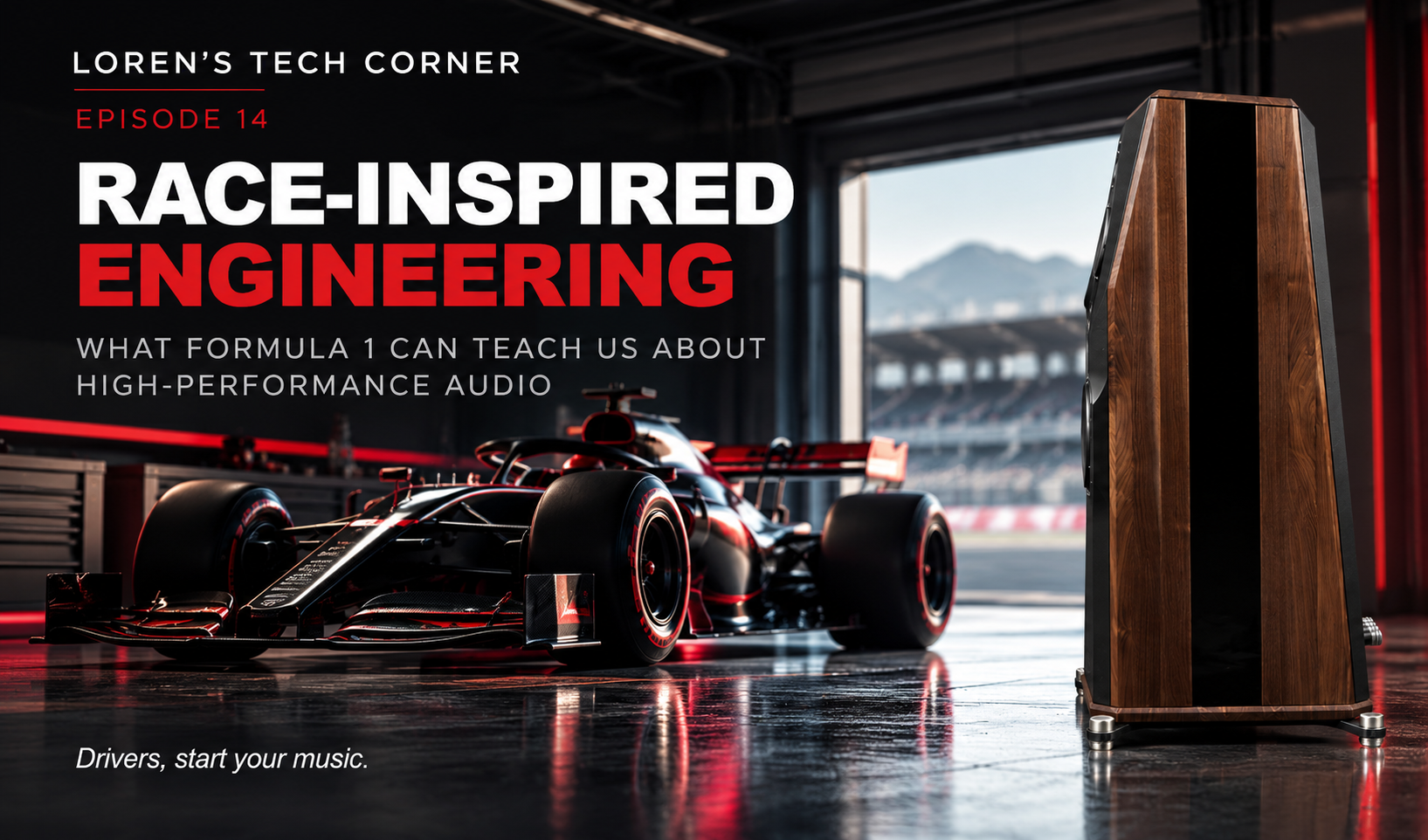
A Formula 1 engine and a high-performance loudspeaker live in completely different worlds, but the engineering mindset behind them is remarkably similar.
Neither achieves extraordinary performance because of one exotic part. The result comes from many tightly controlled decisions working together as one system. That is the useful idea behind comparing Formula 1 engineering with PEAK Sinfonia.
No single part makes the performance.
An F1 power unit only works at its highest level when the engine, chassis, aerodynamics, electronics and cooling systems operate together. A loudspeaker follows the same logic. Drivers, cabinet, crossover, materials and mechanical structure are not isolated ingredients. They are one machine.
That matters to dealers because the same principle continues beyond the loudspeaker. Source, amplification, power, room, setup and placement all become part of the listening result.
Small tolerances. Audible consequences.
Formula 1 components are built to extreme tolerances because microscopic differences can alter performance and reliability. PEAK applies the same discipline to the driver motor system, including voice-coil gaps measured in microns.
Stiffness, damping and stability are selected for controlled behavior, not for brochure theater.
The design has to remain predictable when the system moves from quiet passages to large dynamic demands.
Horsepower is useless without composure.
Formula 1 performance is not simply maximum output. The useful performance is controlled, immediate and repeatable. Loudspeakers face the same challenge. The smallest musical information and the largest dynamic changes have to come from the same moving system without unwanted movement becoming coloration.
Thermal behavior is part of the design.
Heat changes machines. Racing engineers manage it to preserve power and reliability. Loudspeaker engineers manage it to preserve linearity and reduce compression. Different machines, same problem: performance has to survive stress.
The graph is essential. It is not the entire experience.
PEAK development combines simulation, engineering analysis, prototypes and extensive measurement with more than 2,000 hours of listening to individual components. The useful distinction is not measurement versus listening. Measurement tells the engineers how the system behaves. Listening evaluates how effectively the finished system communicates music.
That is a much healthier conversation than pretending either side can replace the other.
Some behavior only appears with time.
The source paper extends the Formula 1 analogy into warm-up and loudspeaker run-in. PEAK’s position is that suspensions, voice coils, diaphragms, adhesives and damping materials can change subtly as they are exercised.
It also acknowledges the controversial part directly: a brand-new Sinfonia can measure essentially like the fully run-in reference while experienced listeners report differences in openness, dimensionality, ease and natural expression. That claim is difficult to demonstrate on a conventional graph and remains debated in the industry, so it is best presented as PEAK’s engineering and listening position rather than as a settled universal rule.
Build the experience as a system.
The Formula 1 comparison works because it redirects the conversation away from the magic part. Great performance is the accumulated result of materials, tolerances, mechanical behavior, thermal control, measurement, listening and integration.
For the integrator, that is familiar territory. We are not assembling a trophy case of impressive components. We are designing a system in which the components stop calling attention to themselves and the experience takes over.